
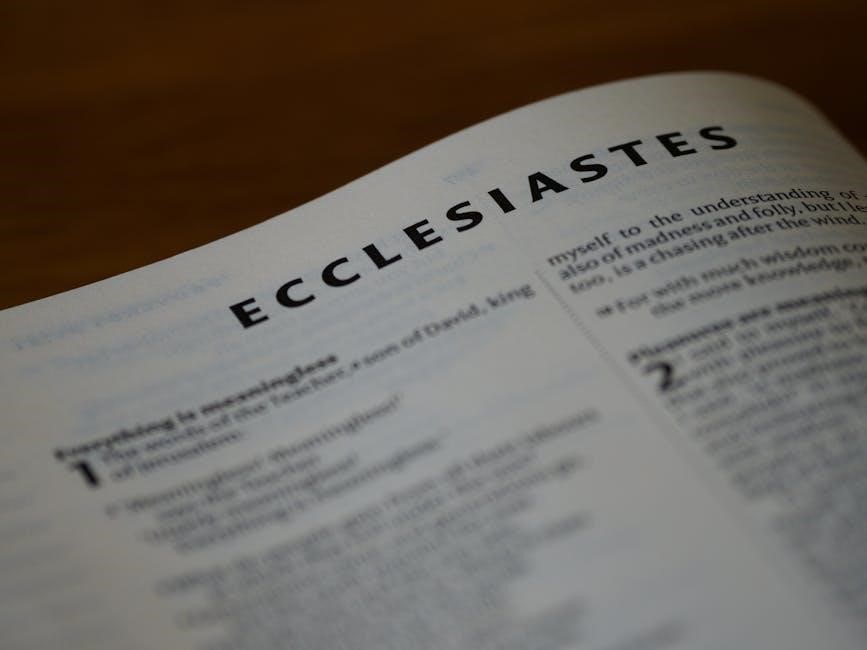
Ecclesiastes‚ presented as the teachings of “Qohelet‚” explores life’s meaning‚ questioning control and advocating for enjoying simple pleasures amidst life’s mysteries․
The author introduces a teacher‚ distinct from themselves‚ offering wisdom and prompting readers to contemplate and draw their own informed conclusions․
A․ Authorship and Date
Determining authorship remains a scholarly debate․ The book opens attributing the words to “Qohelet‚ son of David‚ king in Jerusalem‚” leading to traditional association with King Solomon․ However‚ this is not definitive․
Some scholars propose a later king from David’s lineage‚ while others suggest a teacher adopting a “Solomon-like persona” for instructional purposes․ The actual author remains anonymous‚ acting as an editor presenting and evaluating Qohelet’s teachings․
Dating Ecclesiastes is similarly complex․ If Solomonic authorship is accepted‚ the date would be around 935 BC․ Otherwise‚ a date during the Persian or Hellenistic periods (5th-2nd centuries BC) is more likely‚ reflecting the book’s linguistic features․
B․ The Meaning of “Qohelet”
“Qohelet” is a Hebrew word with a fascinating nuance․ It literally means “one who gathers people together‚” but its function within the text is more specific than a simple assembler․
The term implies a role akin to a teacher or a leader of a deliberative assembly‚ someone who convenes a group for the purpose of instruction and thoughtful discussion․ Therefore‚ “Qohelet” is often translated as “teacher” or “preacher․”
This designation highlights the book’s intent: to present wisdom and provoke reflection‚ inviting readers to listen‚ learn‚ and grapple with profound questions about life’s purpose and meaning․
C․ Genre: Wisdom Literature
Ecclesiastes firmly belongs to the genre of Wisdom Literature‚ a prominent category within the Old Testament․ This genre isn’t focused on law or historical narrative‚ but rather on providing practical guidance for living a virtuous and fulfilling life․
Like other wisdom texts‚ it explores universal themes of meaning‚ purpose‚ suffering‚ and the pursuit of happiness‚ often employing poetic language‚ metaphors‚ and insightful observations about the human condition․
It distinguishes itself through its brutally honest and often skeptical tone‚ questioning conventional wisdom and challenging readers to confront life’s complexities․

II․ Core Themes of Ecclesiastes
Central to Ecclesiastes is the exploration of life’s futility‚ the relentless search for meaning‚ and the crucial role of wisdom in navigating existence․
A; The Futility of Life (“Vanity of Vanities”)
The pervasive theme of “vanity” – often translated as “meaningless” or “absurdity” – dominates Ecclesiastes․ Qohelet repeatedly emphasizes the transient and ultimately unsatisfying nature of earthly pursuits․
He examines wealth‚ pleasure‚ wisdom‚ and labor‚ demonstrating their inability to provide lasting fulfillment․ This isn’t a nihilistic despair‚ but a realistic assessment of life “under the sun‚” acknowledging human limitations and the lack of inherent control․
Recognizing this futility is the first step towards seeking a deeper‚ God-centered perspective‚ as highlighted by the book’s concluding remarks․
B․ The Search for Meaning
Qohelet’s relentless questioning isn’t about dismissing meaning altogether‚ but rather about honestly confronting where true meaning isn’t found․ He meticulously investigates various avenues – work‚ wisdom‚ enjoyment – seeking lasting satisfaction․
His explorations reveal the limitations of human endeavor when divorced from a higher purpose․ This rigorous search‚ though initially appearing bleak‚ ultimately points towards a need for something beyond the material realm․
The book subtly suggests that genuine meaning resides in acknowledging God’s sovereignty and living righteously within His framework․
C․ The Role of Wisdom
Ecclesiastes doesn’t dismiss wisdom‚ but redefines its value․ Qohelet acknowledges wisdom’s benefits‚ yet demonstrates its inability to shield against life’s inevitable hardships – sickness‚ injustice‚ and death․
Traditional wisdom literature often promises reward for righteousness; Qohelet observes that righteous individuals and the wicked often share the same fate‚ challenging conventional notions․
True wisdom‚ within Ecclesiastes‚ lies in accepting life’s uncertainties and finding contentment in God’s providence‚ rather than seeking control or guaranteed outcomes․

III․ Key Concepts and Phrases
Central to Ecclesiastes are phrases like “under the sun” and “chasing the wind‚” illustrating life’s limitations and the futility of purely earthly pursuits․
A․ “Under the Sun” ⎯ A Limited Perspective
The phrase “under the sun” consistently appears throughout Ecclesiastes‚ representing a distinctly human and earthly viewpoint․ It signifies a perspective confined to the observable‚ material world‚ excluding any consideration of divine influence or eternal realities․
Qohelet repeatedly emphasizes that all experiences – joy‚ sorrow‚ labor‚ achievement – occur “under the sun‚” highlighting their temporary and ultimately limited nature․ This framing encourages a realistic assessment of life‚ acknowledging its inherent frustrations and uncertainties without relying on transcendent hope․
It’s a crucial lens through which to interpret Qohelet’s observations‚ reminding readers that his conclusions stem from a purely human vantage point․
B․ “Chasing After the Wind” ― Meaningless Pursuits
“Chasing after the wind” is a central metaphor in Ecclesiastes‚ vividly illustrating the futility of many human endeavors․ This evocative image conveys the idea of pursuing something ultimately insubstantial and unattainable‚ offering no lasting satisfaction or genuine purpose․
Qohelet applies this phrase to various pursuits – wealth‚ pleasure‚ wisdom‚ even diligent work – demonstrating that none can provide ultimate meaning or escape the inevitability of death․ It’s a stark critique of worldly ambitions‚ urging a reevaluation of values․
Recognizing these pursuits as “vanity” is key to understanding Qohelet’s perspective;
C․ The Importance of Enjoying Simple Pleasures
Amidst the pervasive “vanity‚” Ecclesiastes surprisingly emphasizes finding joy in everyday experiences․ Qohelet advocates for appreciating the simple gifts of life – eating‚ drinking‚ and finding satisfaction in one’s work – as acts of grace from God․
This isn’t a call to hedonism‚ but a realistic acknowledgment that since lasting meaning is elusive “under the sun‚” savoring present moments becomes paramount․ It’s a practical response to life’s uncertainties․
These small joys are presented as a divine gift to be received with gratitude․

IV․ Examining the Structure of the Book
Ecclesiastes unfolds in three parts: initial declarations of futility‚ observations on life’s injustices‚ and practical wisdom culminating in warnings and concluding reflections․
A․ The Initial Proclamation of Futility (Chapters 1-2)
Chapters 1 and 2 establish the central theme of futility‚ repeatedly emphasizing the “vanity of vanities” – the inherent meaninglessness of earthly pursuits․ Qohelet investigates wisdom‚ pleasure‚ and ambitious projects‚ like building and acquiring wealth‚ demonstrating their ultimate lack of lasting satisfaction․
These initial explorations reveal a cyclical nature to existence‚ where everything repeats without genuine progress or fulfillment․ The author presents these investigations not as failures‚ but as demonstrations proving that true and lasting meaning cannot be found solely “under the sun․”
B․ Observations on Life’s Injustices (Chapters 3-6)
Chapters 3-6 shift focus to the frustrating realities of life‚ observing injustices like the wicked prospering while the righteous suffer․ Qohelet acknowledges God’s timing and control (“a time for everything”)‚ yet laments the apparent randomness and unfairness within human experience․
He contrasts the limitations of human wisdom with the inscrutability of God’s plans‚ highlighting the futility of striving for complete understanding․ These chapters don’t offer solutions‚ but realistically portray the complexities and disappointments inherent in a world “under the sun․”
C․ Practical Wisdom and Warnings (Chapters 7-12)
Chapters 7-12 deliver practical advice‚ urging readers to embrace simple joys‚ cultivate wisdom‚ and avoid excessive pursuits of wealth or power․ Qohelet warns against rash judgment‚ the dangers of pride‚ and the importance of fulfilling obligations․
He emphasizes the inevitability of death and encourages preparation for it‚ advocating for a life lived with integrity and reverence for God․ These chapters offer a path toward contentment‚ not by solving life’s mysteries‚ but by navigating them with wisdom and humility․

V․ Ecclesiastes and the Problem of Suffering
Ecclesiastes acknowledges hardship as inevitable‚ highlighting the limits of human understanding when facing life’s injustices and seeking contentment amidst difficulty․
A․ The Inevitability of Hardship
Ecclesiastes doesn’t shy away from acknowledging the presence of suffering and injustice within the human experience․ The book portrays hardship not as an anomaly‚ but as a fundamental aspect of “life under the sun․” Qohelet observes that fate befalls all‚ righteous and wicked alike‚ leading to a sense of frustration and questioning․
This perspective challenges simplistic notions of reward and punishment‚ recognizing that difficulties are often unpredictable and beyond human control․ Accepting this inevitability isn’t about resignation‚ but about realistically assessing life’s conditions and finding meaning despite them․
B․ The Limits of Human Understanding
Ecclesiastes emphasizes the inherent limitations of human reason when attempting to grasp the entirety of God’s plan or the reasons behind life’s complexities․ Qohelet repeatedly points out the futility of seeking complete understanding of everything that happens “under the sun․”
Human efforts to decipher ultimate meaning often fall short‚ leading to frustration and a sense of the mysterious; This isn’t a dismissal of wisdom‚ but a recognition that some things remain beyond our cognitive reach‚ requiring humility and trust․
C․ Finding Contentment Amidst Difficulty
Ecclesiastes doesn’t offer a simplistic path to happiness‚ but rather a realistic acceptance of life’s inevitable hardships and injustices․ Despite recognizing the “vanity” of many pursuits‚ the book advocates for finding joy in everyday experiences – eating‚ drinking‚ and enjoying one’s work․
Contentment isn’t about eliminating suffering‚ but about appreciating the good gifts God provides even within a broken world․ This perspective fosters gratitude and resilience‚ allowing one to live meaningfully despite life’s challenges․
VI․ Ecclesiastes and the Fear of God
Ecclesiastes emphasizes reverence for God as foundational for a meaningful life‚ acknowledging divine sovereignty‚ judgment‚ and the importance of accountability in all actions․
A․ Reverence as a Foundation for a Meaningful Life
Ecclesiastes doesn’t explicitly detail religious practices‚ but subtly underscores that a life lived with awareness of God’s judgment provides a crucial framework for purpose․
This “fear of God‚” not necessarily terror‚ but profound respect and acknowledgment of divine authority‚ becomes the catalyst for honesty and integrity․
Despite life’s inherent uncertainties and injustices‚ recognizing God’s ultimate control fosters a life lived responsibly‚ seeking meaning within a divinely ordered world․
It’s a recognition that actions have consequences‚ and a commitment to ethical behavior stems from this foundational reverence․
B․ God’s Sovereignty and Judgment
Ecclesiastes emphasizes God’s ultimate control‚ even amidst apparent chaos and injustice‚ offering a perspective that transcends human limitations and understanding․
The book posits a future judgment where evil will be eradicated and justice will prevail‚ providing a hopeful counterpoint to the frustrations of present life․
This belief in divine judgment isn’t a detailed theological exposition‚ but a foundational assumption that shapes ethical behavior and provides a sense of cosmic order․
Acknowledging God’s sovereignty encourages acceptance of life’s mysteries and a focus on living responsibly in anticipation of accountability․
C․ The Call to Accountability
Ecclesiastes subtly urges a life of integrity and honesty‚ rooted in the anticipation of God’s future judgment and the belief in ultimate accountability for actions․
Despite acknowledging life’s uncertainties and the seeming randomness of fate‚ the book implicitly calls for ethical conduct‚ recognizing a higher moral standard;
This isn’t presented as a system of rewards and punishments‚ but as a natural consequence of believing in a just and sovereign God who will ultimately set things right․
Living with this awareness fosters a sense of responsibility and encourages a life lived with purpose and mindful consideration of one’s choices․

VII․ Contrasting Perspectives: Qohelet vs․ the Epilogue
Qohelet’s skepticism regarding life’s meaning contrasts with the epilogue’s affirmation of faith‚ prompting readers to reconcile these differing viewpoints for a complete understanding․
A․ Qohelet’s Skepticism
Qohelet’s perspective is characterized by a profound skepticism‚ relentlessly questioning the inherent value and lasting significance of human endeavors․ He observes the cyclical nature of life‚ highlighting its futility and lack of ultimate control․
This teacher doesn’t deny the enjoyment of life’s simple pleasures‚ but consistently points out their temporary and ultimately unsatisfying nature․ He challenges conventional wisdom‚ suggesting that wisdom itself doesn’t guarantee a better outcome‚ and that fate often appears arbitrary․
Qohelet’s honesty‚ though often bleak‚ forces a confrontation with the realities of existence‚ prompting a search for meaning beyond worldly pursuits․
B․ The Author’s Affirmation of Faith
Contrasting Qohelet’s skepticism‚ the book’s author offers a concluding affirmation of faith‚ subtly reshaping the teacher’s observations․ This voice emphasizes the importance of “reverence for God” and adherence to divine commandments as the foundation for a meaningful life․
The author asserts that God will ultimately judge all actions‚ bringing justice and accountability․ This perspective introduces hope‚ suggesting that while life “under the sun” may seem meaningless‚ a higher purpose exists within God’s sovereign plan․
The author doesn’t dismiss Qohelet’s insights‚ but reframes them within a theological context․
C․ Reconciling the Two Voices
Understanding Ecclesiastes requires acknowledging the tension between Qohelet’s pessimistic observations and the author’s hopeful conclusion․ The author doesn’t negate the teacher’s skepticism‚ but rather provides a framework for interpreting it․
Qohelet’s exploration of life’s futility serves as a realistic assessment of human limitations‚ while the author’s affirmation of faith offers a transcendent perspective․ This interplay suggests that meaning isn’t found in worldly pursuits‚ but despite their inherent emptiness․
The book invites readers to embrace both honesty and hope․

VIII․ Ecclesiastes and Modern Life
Ecclesiastes resonates today by addressing existential questions and the search for purpose in a secular world‚ urging honesty and integrity despite life’s uncertainties․
A․ Relevance to Contemporary Concerns
Ecclesiastes profoundly speaks to modern anxieties surrounding meaning and purpose․ In a world often focused on achievement and material gain‚ the book’s exploration of “vanity” – the fleeting nature of earthly pursuits – offers a crucial counterpoint․
Its questioning of control resonates with contemporary experiences of uncertainty and hardship․ The book doesn’t offer easy answers‚ but rather encourages honest engagement with life’s complexities‚ fostering resilience and a realistic outlook․
Furthermore‚ the emphasis on enjoying simple pleasures provides a valuable antidote to the pressures of modern life‚ promoting mindfulness and gratitude․
B․ Addressing Existential Questions
Ecclesiastes directly confronts fundamental existential questions about life’s purpose‚ the inevitability of death‚ and the presence of injustice․ It doesn’t shy away from acknowledging the apparent meaninglessness that can permeate human experience‚ prompting deep introspection․
The book’s exploration of “under the sun” – a limited human perspective – highlights the boundaries of our understanding‚ encouraging humility in the face of life’s mysteries․
By grappling with these difficult themes‚ Ecclesiastes invites readers to define their own values and find meaning within a finite existence․
C․ Finding Purpose in a Secular World
Ecclesiastes offers surprising relevance in a secular context‚ acknowledging the human search for meaning beyond religious frameworks․ It suggests finding fulfillment not in grand achievements‚ but in appreciating everyday joys and practicing honesty․
Despite recognizing life’s inherent limitations‚ the book advocates for diligent work and enjoying the fruits of one’s labor‚ fostering a sense of purpose within a finite existence․
Ultimately‚ Ecclesiastes encourages embracing life’s simple pleasures and living ethically‚ even amidst uncertainty and apparent meaninglessness․

IX․ Literary Devices in Ecclesiastes
Ecclesiastes masterfully employs repetition‚ parallelism‚ vivid imagery‚ and striking antithesis to emphasize its themes of futility and the search for meaning․
A․ Repetition and Parallelism
Repetition is a cornerstone of Ecclesiastes’ style‚ notably the recurring phrase “Vanity of vanities‚ all is vanity!” This emphasizes the transient and ultimately meaningless nature of earthly pursuits․
Parallelism‚ a common feature of Hebrew poetry‚ structures verses with similar ideas expressed in successive lines‚ reinforcing concepts and creating a rhythmic flow․ This technique isn’t merely stylistic; it deepens the impact of Qohelet’s observations on life’s cyclical patterns and inherent frustrations․
These devices aren’t accidental; they actively shape the reader’s experience‚ driving home the book’s central message about the limitations of human endeavor․
B․ Imagery and Metaphor
Ecclesiastes powerfully employs vivid imagery and metaphor to convey abstract ideas about life’s futility․ The prominent metaphor of “chasing after the wind” encapsulates the frustrating and ultimately unfulfilling nature of striving for worldly achievements․
Other recurring images‚ like the cyclical return to one’s place‚ underscore the repetitive and predictable patterns of existence․ These aren’t simply decorative; they are integral to Qohelet’s argument‚ illustrating the limitations of human control and understanding․
The author uses these tools to make complex philosophical points accessible and emotionally resonant․
C․ Use of Antithesis
Ecclesiastes frequently utilizes antithesis – the juxtaposition of contrasting ideas – to highlight life’s paradoxes and uncertainties․ Qohelet presents seemingly opposing truths‚ such as wisdom versus folly‚ or gain versus loss‚ forcing readers to grapple with complexity․
This technique isn’t meant to offer easy answers‚ but rather to demonstrate the inherent contradictions within the human experience․ The author skillfully employs this literary device to challenge conventional wisdom and provoke deeper thought․
It underscores the book’s central theme: the difficulty of finding lasting meaning․

X․ Historical Context of Ecclesiastes
Ecclesiastes’ origins are debated‚ potentially linked to Solomon or later Israelite periods‚ reflecting ancient Near Eastern wisdom traditions and societal influences․
A․ The Reign of Solomon (Traditional View)
Traditionally‚ Ecclesiastes is attributed to King Solomon‚ renowned for his wisdom as depicted in 1 Kings․ This view connects “Qohelet” – meaning “teacher” or “one who gathers” – to Solomon’s role as a royal instructor and philosopher․
However‚ scholars note linguistic and stylistic differences suggesting a later date․ If Solomon is the author‚ the book offers a unique perspective on his experiences with wealth‚ power‚ and the limitations of earthly pursuits․ This interpretation frames the book as a royal reflection on life’s complexities‚ penned during a period of peace and prosperity․
B․ Later Periods of Israelite History
Alternatively‚ some scholars propose a composition date during the Persian or Hellenistic periods‚ potentially the 3rd century BCE․ This suggests “Qohelet” adopted a “Solomon-like persona” for teaching purposes‚ a common practice in ancient literature․
This perspective accounts for the book’s refined Hebrew and philosophical nuances‚ reflecting exposure to broader cultural influences․ A later date explains the absence of explicit references to Israel’s covenant history‚ focusing instead on universal human experiences and existential questions․ This view emphasizes the book’s wisdom tradition rather than direct authorship․
C․ Influence of Ancient Near Eastern Wisdom Traditions
Ecclesiastes shares thematic and literary parallels with wisdom literature from Mesopotamia and Egypt‚ like the Epic of Gilgamesh and Egyptian lamentations․ These texts explore similar anxieties about life’s brevity‚ the inevitability of death‚ and the search for meaning․
The book’s skeptical tone and emphasis on observing “under the sun” resonate with ancient Near Eastern perspectives on fate and human limitations․ This suggests Qohelet drew upon a broader intellectual milieu‚ adapting existing wisdom motifs to a uniquely Israelite context․